master plan
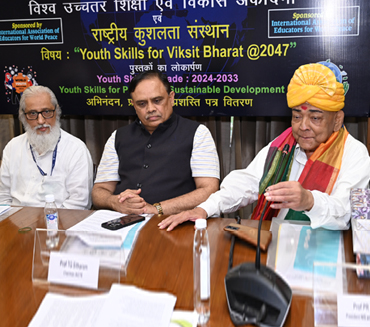
The President designate Hon'ble Pranab
Mukherjjee congratulating the Founder President of
the National Institute of Skilling (NIS), a Division
of the World Institution Building Programme (WIBP)
on 24th July 2012 at New Delhi
1.
Infrastructure Expansion:
o Establish Training Centers in all major cities by 2030..
o Develop Regional Centers in Rural Areas by 2030.
o Construct specialized facilities for high-demand sectors.
2. Programme Diversification:
o Introduce new programmes in emerging fields such as AI, IoT, and
renewable energy.
o Expand existing programmes to cover more industry verticals.
3. Faculty and Staff Development:
o Regular training and upskilling for Faculty.
o Recruit industry experts as Guest Lecturers.
4. Industry Partnerships:
o Formalize partnerships with leading Companies for internships and
placements.
o Collaborate with International Organizations for knowledge
exchange.
5. Technological Advancements:
o Implement e-learning platforms for remote skill training.
o Use simulation and virtual reality for hands-on training
experiences.
6. Research and Innovation:
o Establish a dedicated R&D wing for skill gap analysis and
curriculum development.
o Partner with academic institutions for collaborative research
projects.
20-Year 100-Point Strategy (2012-2032)
Phase 1: Foundation
1. Establish the main campus and initial training centers.
2. Develop core training programmes and curriculum.
3. Launch awareness campaigns.
4. Recruit initial faculty and staff.
5. Formulate partnerships with key industries.
6. Secure initial funding and grants.
7. Develop certification and accreditation processes.
8. Start first batch of training programmes.
9. Conduct baseline skill gap analysis.
10. Implement quality assurance mechanisms.
Phase 2: Expansion
11. Establish training centers in all major cities.
12. Introduce online training modules.
13. Expand curriculum to include emerging technologies.
14. Develop specialized training facilities.
15. Launch faculty development programmes.
16. Formulate industry advisory councils.
17. Initiate international collaborations.
18. Conduct annual skill gap surveys.
19. Start mobile training units for rural outreach.
20. Develop a comprehensive alumni network.
Phase 3: Consolidation
21. Open regional centers in rural areas.
22. Expand programme offerings to cover more sectors.
23. Integrate advanced technology in training methods.
24. Strengthen quality assurance systems.
25. Launch a national skilling portal.
26. Establish a scholarship fund for underprivileged students.
27. Conduct large-scale job fairs.
28. Initiate skill competitions and hackathons.
29. Publish annual reports on skill development.
30. Formulate a national skilling policy.
Phase 4: Innovation
31. Set up a dedicated R&D wing.
32. Introduce courses on next-gen technologies.
33. Partner with global skilling organizations.
34. Develop customized training for different demographics.
35. Launch incubation centers for skill-based startups.
36. Promote lifelong learning programmes.
37. Implement AI-based training assessment tools.
38. Expand international student exchange programmes.
39. Introduce gamified learning modules.
40. Develop a comprehensive digital library.
41. Establish industry-sponsored labs.
42. Conduct nationwide skill contests.
43. Implement blockchain-based certification.
44. Promote green skilling initiatives.
45. Launch virtual reality-based training.
46. Develop a robust data analytics framework.
47. Form alliances with leading tech firms.
48. Conduct impact assessment studies.
49. Establish a center of excellence in each major sector.
50. Create a skilling think tank for policy recommendations.
Phase 5: Leadership and Legacy
51. Achieve global recognition for skilling excellence.
52. Expand training programmes internationally.
53. Establish NIS as a thought leader in skill development.
54. Develop a global skilling consortium.
55. Launch a NIS publication for skill research.
56. Achieve financial sustainability through diverse funding
sources.
57. Organize international skilling conferences.
58. Develop a global alumni network.
59. Create a comprehensive skill development index.
60. Promote sustainable development goals through skilling.
61. Establish a virtual university for skills.
62. Launch a NIS TV channel for skilling content.
63. Develop an AI-driven career counseling system.
64. Promote inclusive skilling for differently-abled individuals.
65. Conduct global internships and training programmes.
66. Establish NIS as a UNESCO center for skill excellence.
67. Develop a model for public-private partnerships in skilling.
68. Expand R&D collaborations globally.
69. Achieve zero-carbon footprint for all NIS facilities.
70. Develop an emergency response skilling programme.
71. Promote arts and crafts through specialized training.
72. Launch a global skill development fund.
73. Develop smart campuses with IoT integration.
74. Establish a center for ethical hacking and cybersecurity.
75. Promote digital literacy for all age groups.
76. Develop training for sustainable agriculture practices.
77. Achieve top rankings in global skilling indices.
78. Establish an innovation and entrepreneurship center.
79. Create a global skilling app.
80. Promote cross-border skilling initiatives.
81. Develop an integrated skilling ecosystem.
82. Achieve a gender-balanced skilling participation.
83. Promote wellness and mental health training.
84. Establish a global skilling advisory board.
85. Develop a comprehensive skill mapping system.
86. Promote multilingual training programmes.
87. Achieve high employability rates for NIS graduates.
88. Develop skill-based curriculum for school education.
89. Promote volunteerism through skill-based community service.
90. Establish a skilling museum and archive.
91. Develop skilling programmes for disaster management.
92. Promote ethical practices in all training programmes.
93. Achieve 100% digital literacy for all NIS trainees.
94. Establish a global center for skill research.
95. Promote intergenerational learning programmes.
96. Develop skill-based solutions for global challenges.
97. Achieve high levels of trainee satisfaction.
98. Promote regional and cultural diversity in skilling.
99. Develop a comprehensive talent management system.
100. Ensure continuous innovation in skilling methodologies.
Events
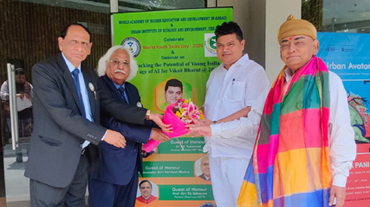
2026: 15 July 2026-World Youth Skills Day Celebration
World Youth Skills Day 2026 was being celebrated at the India International Centre, New Delhi with the theme "Unlocking the Potential of Young India in the Age of AI for Viksit Bharat@2047". View Photos
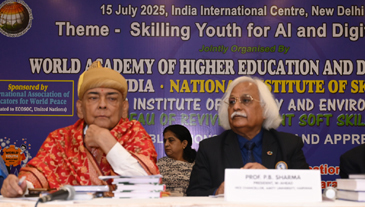
2025: 15 July 2025-World Youth Skills Day Celebration
World Youth Skills Day 2025 was being celebrated at the India International Centre, New Delhi with the theme Skilling Youth for AI and Digital Skills and the Seminar On: Unlocking the Potential of Technical Education for Skilling, Research and Innovation for Viksit Bharat @2047. View Photos
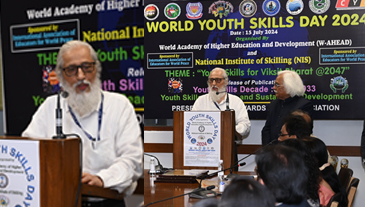
2024: 15 July 2024-World Youth Skills Day Celebration
World Youth Skills Day 2024 was being celebrated at the India International Centre, New Delhi with the theme "Youth Skills for Viksit Bharat@2027", sponsored by International Assocition of Educators for World Peace (An Affiliate of United Nations ECOSOC) jointly organised by World Academy of Higher Education and Development and National Institute of Skilling. View Photos